Inside Archive X: Curating the Impossible with Dr. Jeffrey Kripal
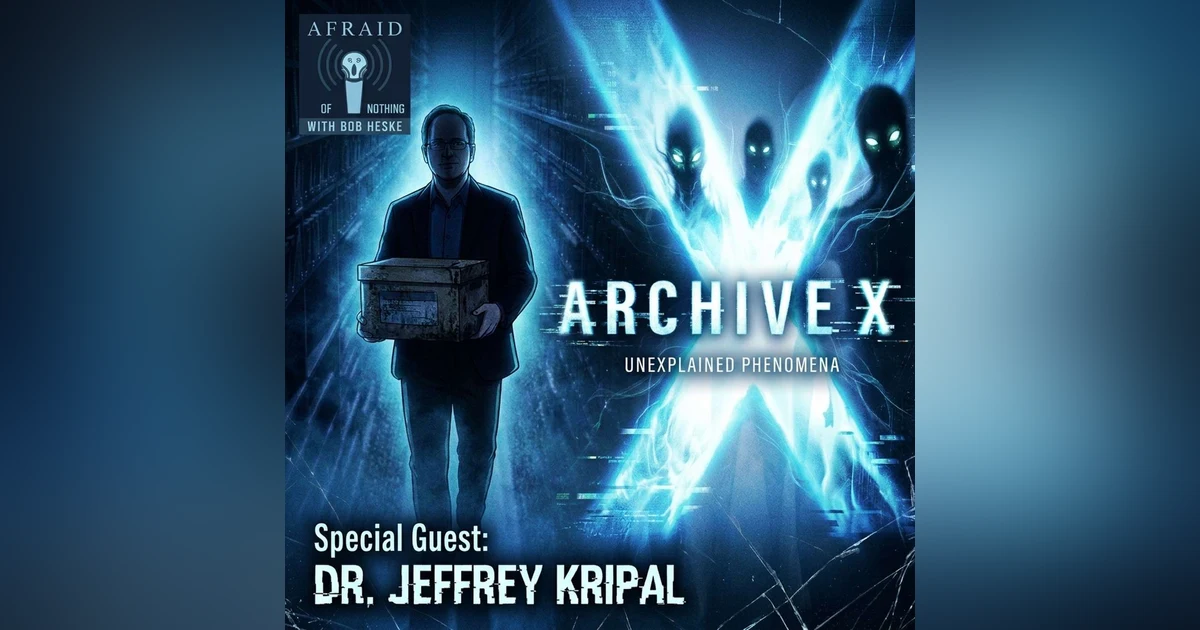


What happens when a leading religious scholar opens the vaults on over a million documents of UFO encounters, near-death experiences, telepathy, and unexplained phenomena?
In this episode of Afraid of Nothing, host Bob Heske sits down with Dr. Jeffrey J. Kripal—professor at Rice University, founder of the groundbreaking Center for the Impossible (also known as the Archives of the Impossible), and host of the six-part docuseries Archive X: Unexplained Phenomena on AMC+ and SundanceTV.
Together, Bob and Dr. Kripal dive deep into what it takes to bring fringe and anomalous experiences from the margins into serious academic and mainstream conversation.
In this episode, we discuss:
- Hosting Archive X: Unexplained Phenomena: Behind the scenes of turning real-world experiencer testimonies and historical records into a television docuseries.
- Curating the Impossible: What it’s really like overseeing Rice University’s massive paranormal archive—housing collections from UFO researchers, psychic programs, and everyday experiencers.
- Bridging Worlds: How near-death experiences, prophetic dreams, alien abductions, and mysticism all connect.
Guest Bio: Dr. Jeffrey J. Kripal
Dr. Jeffrey J. Kripal holds the J. Newton Rayzor Chair in Philosophy and Religious Thought at Rice University, where he founded the Center for the Impossible (Archives of the Impossible) at the Woodson Research Center. He also serves as Co-Director of the Center for Theory and Research at the Esalen Institute in Big Sur, California. The author of numerous acclaimed books—including How to Think Impossibly and The Superhumanities—Dr. Kripal is the host of the AMC+/SundanceTV docuseries Archive X: Unexplained Phenomena.
Important Links
- Official Website: Jeffrey J. Kripal, PhD
- The Archives: Center for the Impossible
- Watch the Series: Archive X: Unexplained Phenomena on AMC+
- Author Page: Jeffrey J. Kripal Books
- Academic Profile: Rice University Faculty Page
Like what you hear? Let us know.
$10 Afraid of Nothing merch - and more - at the Afraid of Nothing Shopify store. Visit afraidofnothingpodcast.com or use this url:
https://www.afraidofnothingpodcast.com/p/shopify-store/
Never be afraid to look good and have cool merch!
SUPPORT THE PODCAST
NEW: SHOP OUR STORE ON SHOPIFY!
Never Be Afraid to Look Good at https://383e86-d1.myshopify.com/.
FOLLOW/SUBSCRIBE/REVIEW...
On our website at afraidofnothingpodcast.com.
SUBSCRIBE...
Your gracious donation here helps defray production costs. Beyond my undying gratitude, you will also will be shouted out in an upcoming episode.
WATCH ON YOUTUBE...
We are uploading past episodes on our Youtube channel.
WATCH THE DOC…
- VIMEO ON DEMAND: Rent the Afraid of Nothing documentary here: https://vimeo.com/ondemand/aondoc.
- TUBI: watch for free with ads on tubitv.com.
REVIEW OUR FILM ON ROTTEN TOMATOES...
Write your five-star review here.
In a world where nothing is known, nothing is certain. Reality is not real. Be afraid. I'm Bob Hatchkey, Robert.
SPEAKER_01The host with the ghost.
SPEAKER_00This is my podcast based on my paranormal documentary, Afraid of Nothing. Each episode we talk to people who see life and the afterlife through a different lens. Join me.
SPEAKER_02Who is this large man? And what's he doing in our bedroom?
SPEAKER_00As we lift the veil and open our minds to see beyond our eyes lie. This is Afraid of Nothing. So I have been watching a show on AMC Plus called Archive X, and I gotta tell you, it's one of those paranormal shows. I can't wait till the next episode drops. I've seen five so far and then really enjoyed them all. It's very unique. I think it's a pretty unique concept, and I love the way it includes experts and experiencers. And we are blessed to have the host of the show, Jeff Krypal. Hi, Jeff. Welcome to the show.
SPEAKER_03Hi, hi Robert. Nice to be here.
SPEAKER_00So, Jeff, I'm going to ask you a not so humble introduction about yourself.
SPEAKER_04I've I've looked at you online. There's a ton of stuff. You've written a ton of books with some impressive people, and you are also called the Yoda of the Paranormal. So if you could kind of give our audience a quick overview, but uh don't skip the the details of who you are and what you've done.
SPEAKER_03Yeah, so I usually do this um too quickly. Um you you can ask for more. Um so I'm the the official title is the J. Newton Razor Professor of Religion and Philosophy at Rice University. And I've been in the academy now for officially 33 years since 1993. I did my PhD at the University of Chicago, uh finished in 93, and I got into the paranormal really about 20 years ago through a variety of means. And I've been talking to people ever since. Um I started the Archives of the Impossible, which is now the Center for the Impossible, uh back in 2000, probably 2014, through a man named Jacques Villet, and uh who's our first donor um to the archives. And we can talk more about the center for the impossible as as we go on here. But but that's essentially what I do now, is that's my main line of work um at the university. But I I teach, Robert. I mean, I I I I have a day job and uh you know and a night job, I suppose. And uh uh my my day job is just teaching comparative religion at a at a major research university. So
SPEAKER_04what is comparative religion and how did that impact you? Uh I I have uh dating someone who's super religious, and she hates that I do a paranormal podcast and have a Ouija boards in the house and things like that. So how did that work with you, you know, regarding your faith and and and what you do now?
SPEAKER_03Well, so the study of religion is not religion,
SPEAKER_04okay,
SPEAKER_03Robert. You know, I mean one of the the jokes I tell is the the last class you want to take if you want to maintain your faith is is a class on the religion. Because we'll we'll tell you where these ideas and beliefs came from and and and why you believe what you believe. And so on the other hand, I do think that the study of religion is about reality. I think people are are experiencing reality and they're framing it or their their experiences are framing it in religious ways. So it's it's it's a kind of both and slice, uh, is what I'm trying to say. It's it's it's it's there's a there's a deep sympathy to what I do for religious people, but there's also a deep criticism uh to what I do as well.
SPEAKER_04So do some students leave crush fallen because their their their beliefs are gone at the end, or they they ever come up to you discuss things.
SPEAKER_03I think it depends on what kind of belief. You know, you asked about comparison. Comparison is basically the big picture. You know, we're looking at the human religious experience globally and back to as far as we can see, which is really the the cave drawings or the cave paintings. Um and so any kind of faith that is exclusive, um, that thinks that they have the truth and other people don't, yeah, it's a big challenge. This is a huge challenge to that. But it doesn't call into question the idea of being religious. Um, human beings are naturally religious. Um so it just depends on what kind of faith one has, I think, going in. And generally, students are not crestfallen, by the way, to answer your question. They're they're affirmed, but it pr but they're also opened
SPEAKER_04up
SPEAKER_03to other other human beings. I would like to take your
SPEAKER_04course. Um so yeah, so let's talk about what was the uh paranormal incident, or uh are you an experiencer yourself, or what prompted you to start this 20 years ago?
SPEAKER_03I don't have these experiences. It's it's true I did once. I had one of these experiences in 1989. I had an out-of-body experience in Calcutta uh when I was doing my dissertation, which made me deeply sympathetic to experience or accounts, but I don't, I don't, I'm not a I'm not a magus. I don't I don't walk around, you know, uh uh sunk in these experiences. But I have heard so many, Robert. I, you know, human beings as a whole do have these experiences all the time. Um and I become absolutely convinced of that. And I don't think it actually matters whether I do or not. Uh I don't think I matter, to be to be really blunt about it. Uh I don't think you matter, by the way. I I don't think any of us matter individually, but but collectively as a species, we're we're extraordinary and uh we're super, as I say. Um and so that that's really the argument. You know, that's the bigger argument.
SPEAKER_04So I think you have the perfect demeanor to be the curator for an archive. I know a gentleman who is the curator of the Talking Board Museum in Salem, Massachusetts. And because I did a uh documentary and he was in it, did a little thing. And he really doesn't believe in documentaries too much, I'm sorry, in Ouija boards too much, so it never affects him, whatever comes to the museum or not. And I I think you walking through this vast archive of things, uh, you know, one of the questions I was gonna ask you later was has anything followed you home? But it seems like you vibrate on a certain level so that you're interested but unaffected for the most part. Is that accurate?
SPEAKER_03Yeah, yeah, I mean, I think I'm deeply affected, uh, but in a very positive way. I think my viewpoint is much more cosmic or much more open to other other things now. I um but but hit the hitchhiker hitchhiker effect that you're referring to, it does not follow me home. No, I I do not have these experiences, particularly the negative ones. And and some people do experience this negatively, but not everyone, by the way, Robert. And I don't think that the goal or the end point or the meaning of these events are are negative at all. I think they're quite positive.
SPEAKER_04So, how did it happen that Archive X came to came into being? Because it seems like it's a great idea, and it you I'd never heard of this before at your college. And um, you know, it seems like that would have been a great job of a lot of the other stuff that's on. So did someone just call you out of the blue or
SPEAKER_03no, no, no, it's not out of the blue at all. I mean, I've been in this zone now for almost 20 years, really over 20 years. And, you know, about in 2005 or 2004, my joke was I got tired of writing for 50 people in the world, 25 of whom hate me. And that that's pretty much the definition of academic writing. And so at that point, I tried to reach a bigger and bigger audience. And I've been working with filmmakers really since 2010. Uh, and filmmakers and television people, you know, they're a they're a different breed. And they love the archives, by the way. They love them visually. Uh, and I think what the archives at a university do for a filmmaker is they root the phenomena in really serious conversation and research. And so there's this combination in Archive X between um a university and a and a broader discussion, but also extraordinary human experience that doesn't fit anywhere into these models. Uh, and and as in as an intellectual myself, I I love the fact that it doesn't fit in. You know, that's that's a good thing. That's a good thing, not a bad thing.
SPEAKER_04My mother was a librarian growing up. I mean, what do you use to sort stuff? The Dewey Decimal system, or do you have like a special? How do you catalog? Because if the opening shot of you walking through this huge warehouse, almost like this Amazon warehouse, but a little bit more eerie, probably uh I don't know, climate controlled. Um
SPEAKER_03It it is, by the way. It's really cold in there, by the way.
SPEAKER_04That would be very cool if like cold air was coming out of your mouth in the intro. But uh you know, do you ever forget? Like I forget what my car keys are or stuff. Do you ever forget like where something is? I have a hard time placing it, or or not at all?
SPEAKER_03Of course, of course. You know, I'm I'm a human being. And you know, when I when I've worked in, when I've helped archive the archives, my profound sensibility is humility. Uh, and by that I mean finitude. I mean I feel very small. There are so many documents. We we haven't counted them all, but we we think around a million,
SPEAKER_04wow,
SPEAKER_03you know, in all of it. And um it's just stunning, Robert. I mean, I I can't I can't exaggerate how stunning the collection is and how extraordinary human beings are that are are in that archive. Um and I know I'm babbling, but but it's true, it's really true. Um and they the pictures you see in the television series, you know, me walking through the archive, those that's real. Uh that's what the archive actually looks like. Uh, and it's 58 degrees in there, by the way. It is climate and it's freaking cold. If you don't, if you stop walking and you sit, which I do a lot in the series, oh, it's it's not good.
SPEAKER_04Who will be after you? Because you're a unique person, you have all this knowledge. Are you grooming anyone for like after you?
SPEAKER_03Well, that that's the beauty of an archive, is it it does, it's intergenerational, as I say. It does not depend on on Jeff uh personally, because I will I will disappear, I will, I will retire and I will die at some point. And and um and the archive will go on. And and so a lot of the donors of the archive, a lot of the people who have given their life work, they know this. And you know, there are a lot of young, the fact is there are lots and lots of young intellectuals, academics who who will take my place or take this place. They they desperately want to talk about these things, and not because they want to self-promote it anyway, they just they find them fascinating. And we I host, I host a series of conferences here called Archives of the Impossible Conferences, and they're just they're just rockets going off, Ronner. I mean it we have we have physicists, astronomers, we have geneticists, we have historians and philosophers and anthropologists and sociologists, experiencers. They all want to come and they want it they want these things to be talked about in a rigorous way. And so that's what we provide is that that that rigor.
SPEAKER_04So let's talk about the series. Let's talk about the structure of it. So the structure is pretty much I've watched five episodes so far. Can't wait for this. It's six total in a series. Yeah,
SPEAKER_03yeah. Yeah, there's six in this first season, which is all we've been which is all AMC has committed to. So
SPEAKER_04basically the premise is you know, you have a topic, for example, the third one was Dark Visions, it was free cog. Uh I've had Eric Worgo on the show. The first one really got me. It was about uh telepathy and children. And I have an autistic daughter, and um, she hasn't been to the hill, by the way. She's a different place she goes to, but she's like an energy reader, she reads energy, you know.
SPEAKER_03Yeah,
SPEAKER_04um, and she's she's brilliant. She's done, she's had some stuff that had blown, she blew a shaman away one time when he was doing a healing and she went to meet him there. She could sense his energy and she went to meet him. So yeah, it's it's I I I was the so I love it. So each each show has a certain topic. You have an expert with you, in-house expert, and then you watch tapes of uh a couple experiencers, basically, right? And they can be different angles or similar angles of what the topic is. They could have different, you know, near death experiences could have a total different, you know, after effect, you know. So why don't you just take us through the five episodes just at a high level, what each one's about and and uh what they can expect.
SPEAKER_03Yeah. Yeah, I mean, so again, the base the basis of the series as a whole is that all things, these are all connected. And we don't know how, but we can't have a conversation about how they're connected until we think that they're real. Uh, and so what these different episodes do is they basically begin in the archive and then they move to these two experiencers, and then they move back to the the archive to the experts, as it were, who comment on these these kinds of
SPEAKER_04things.
SPEAKER_03And they
SPEAKER_04leave you so
SPEAKER_03the first
SPEAKER_04experiencer leaves you with a new piece of inventory for the archive.
SPEAKER_03Yeah, that's correct. Um, you know, so the first episode is on telepathic, autistic daughters, basically. Those are the two experiencers, and we look at this relationship between autism and and telepathy with with a with a with a psychiatrist who's studied this for 15 years now, um, Diane Hennessy Powell. Um, and then the second episode uh is on alien abductions, and we look at abductions, um we look at two two two women actually, uh Karin Austin and Young Brinson, and and my uh fellow researcher is Michael Masters, uh, and we comment on it. And then the third episode is on precognition and you know, knowing what's gonna happen before it happens. And these are not predictions, as I say. These are not guesses, these are not coincidences. These are people who know what's gonna happen. So
SPEAKER_04can I stop you there real quick? Um where we stand today with all the doomsday stuff. How long ago with these films? What a year ago or six months ago?
SPEAKER_03No, this was this was in uh March, April, and May.
SPEAKER_04So have they ever come back and given you precognition about you know where we're at now or no? Or do you kind of avoid that?
SPEAKER_03Well, the the thing about the thing about precogs and you know, which was called pro has been called prophecy or divination and different contexts, it's not always accurate, of course. Um, but sometimes it is, and and eerily and uncannily so, but you don't know how accurate it is until after the event. That's that's the the drawback here, or the the hesitation. So I'm not because I study religion, Robert, I'm not a fan of the end of the world.
SPEAKER_04Okay. Neither am I, by the way.
SPEAKER_03Yeah, I think you know, my joke is the end of the world is always coming. You know, every generation thinks it's the last generation. And the the problem with that is we now have the technology to make that happen. We now have the nuclear bomb. We we can actually do that, you know, we can end the world uh today, actually, or tomorrow, or the you know, next year. Um so I I wanna I want to be careful there with what I'm saying, but but the the idea that the world is gonna end is as old as the hills. I mean, that's that's just written into the into the record. You are the most calm person
SPEAKER_04in today that I've ever heard talking about that. I mean, I'm I'm loading up on Walmart for prepper stuff because I I know I'm not gonna last more than a week or two, but you know, it's
SPEAKER_03you're probably buying lots of toilet paper and you know. Stuff I hadn't
SPEAKER_04thought about, you know, uh, but I can't get it. A lot of it's sold out, by the way, like butane and things like that.
SPEAKER_03You know, I my view is look, if the world is gonna end, it's gonna end. And we're in this together, and you know, I wanna I want to be with other people, and um but I don't I don't think the world's gonna end. I think I think you know, history is very kind to us and it's a very good thing to study because you realize how common these sensibilities are.
SPEAKER_04So getting back to the third episode, Dark Visions, one of the questions was free will, do we have it or not?
SPEAKER_03Yeah.
SPEAKER_04And Eric Wargo was on it, and his thought is that you know, we can affect the future with retrocausation, I think, you know, um, where we can the future can affect what happens in the past, which means, you know,
SPEAKER_03yes.
SPEAKER_04And so your question was if that's the case, do we have free will? So coming out of that episode, what was your feeling about that?
SPEAKER_03Well, my feeling about that issue is we we do have free will on this level, but we don't there's there is no free will on a cosmic or or or block universe determined level, you know. So I think it is a matter of levels or or or uh degrees. Um I I and again, I think the precognition is very challenging to us philosophically, precisely because of this, is we want to imagine that we are the agents in the universe, and we're actually the only agents in the universe, and I don't think either of those is true. Um uh and I there's a lot of reasons I think that. Um but but the the the episode on precognition, you know, it really comes down to Robert, it really comes down to you listen, do you listen to people or not?
SPEAKER_04I've started a dream journal. I just started which my dreams haven't been that good lately, I'll be honest with you.
SPEAKER_03And listen to everyone. And if you listen to everyone, you just end up going down rabbit hole after rabbit hole, you know, because you then you have to take everyone's experience seriously, and that's what the series tries to do, including the religious experiencers. It tries to take them seriously, and but it also takes the experience that's not religious seriously, and it it it it takes everything, everything is on the table, as it were, the conversation. And um, I think that's what's new to people. It's not a rational debunking episode. There's no there's no skeptic, you know, there's nobody offering uh uh a rationalist uh alternative, but there's also we we're also skeptical of the religious uh response, although not resistant to it either. We're trying to go down this middle that's that's neither science nor religion.
SPEAKER_04So um before we go on to episode four or five, and if you'll give me a sneak peek to six, number one, your your co-host was best known for the telepathy tapes, correct?
SPEAKER_03Yeah, Diane Hennessy. Yeah, great guest.
SPEAKER_04Um and the second one, uh Mike Master is very well known too. What's his take on aliens? Did he tell you off aside that he thinks they're future versions of us? Does he think they're interdimensional, uh, they're demons? Did he talk about that at all? Or
SPEAKER_03well, Mike's Mike, again, Mike, it's not that Mike, that's the only model. It's it is a it is a model that works for particular cases really well. And I think Mike would say that, but he wouldn't offer that as a you know as a as a model that explains everything. And certainly uh Eric wouldn't, and I wouldn't either. It's just it's one of the things we need to talk about.
SPEAKER_04So let's talk about episode four and five. Give us an overview of what those two are.
SPEAKER_03So four is is um communication with the dead, basically. And my researcher or my colleague is Nicole Bauer, and we look at uh we look at cases of both spirits but also people who have who experience possession. And and um we look at both, and we try to again we tried to to to go this middle middle road that that is neither neither on the the mediumship l way but also neither on the possession way.
SPEAKER_04And what's interesting is after the near-death experience they are profoundly changed.
SPEAKER_03Well, the okay, the near so the fifth episode. It's on near-death experience. Oh, I'm sorry. Go ahead.
SPEAKER_04Yeah, okay.
SPEAKER_03Robert. Yeah. So the fifth episode is uh Elizabeth Crone, whom I know extremely well, and Shirley Black, and it's on the near-death experience.
SPEAKER_04Okay.
SPEAKER_03And that's a that's another whole topic. It's a whole whole nother issue that involves things like precognition and immortality and communication with the dead, as it were. But it's a different it's a different phenomenon. It's a different experience. And people who have
SPEAKER_04near-death experiences, not only are they profoundly you didn't you have uh who's the uh neuro neurosurgeon?
SPEAKER_03Evan. Evan Alexander was was the host, was the researcher. He's the neurosurgeon. So
SPEAKER_04he was uh a real scientific guy, and then it happened to him. He was you know
SPEAKER_03Well, he was a materialist. Again, I don't equate science with materialism, and and nor does Ebon. And you know, because you can do really, really fine science and not be a materialist, but a lot of a lot of science it does assume materialism. And by materialism, I mean everything in the world is ultimately matter, it's ultimately dead things bouncing around in empty space, as it were. And um that's just one again, it's one interpretation of of the facts of the the the of reality.
SPEAKER_04So, Jeff, can you give us a teaser of what the sixth episode is and when it's gonna drop?
SPEAKER_03Well, the sixth episode will come out on Thursday. We'll come out you know in a few days here. Uh, and it's called Angels and Demons, or it's on Angels and Demons, but it's it's it's not, you know, Nancy Burson, uh, an artist, is is offering a more secular interpretation of her experiences. And uh Fringe, as she's called, is offering a more religious interpretation of hers. So we're we're we're countering or we're comparing these religious and non-religious interpretations. And we're we're again we're trying to have that conversation, you know, that goes down the middle. But it's very much about um these religious and these non-religious interpretations of extraordinary phenomena.
SPEAKER_04Now, of those episodes, is there one that really left you impact, and you're like, oh my god, this is like uh hits me a little different.
SPEAKER_03I think well you know, my joke is nothing surprises me, Robert. Um because I've heard all these stories before. And but there's something about the first one that I think does hit parents. You know, a lot of us are parents, and there's something very human about being a parent and having a daughter or a son, and and um so that to me, that that episode I think is extraordinary. I also really like the precognition episode, um, because I think precognition is basically our strongest uh uh phenomenon. It it's it's so it's so evident and so powerful uh in in the in the record. Um so probably those two were were my and you know the ones that that hit me the hardest. I
SPEAKER_04watched uh I watched the first episode again with my daughter, who's autistic. She's pretty high functioning, she's not like I would say moderate, you know, but she's in plays and she has a little hard time with communication sometimes, but she can get up and do a speech and things like that. So I watched it with her and she she was she was glued to it, you know, and and she enjoyed it. And but I asked her about the hill, and she said, No, I don't go there, I go somewhere else, she said, you know, and so she's I don't know where she goes, but there is a place that she goes a lot. She has uh some interesting stories. I did a uh a YouTube video called the uh the ghost in Emily's Crib a while ago, back before cameras were good. And in her baby monitor, my ex-wife was telling me for weeks, God, what's that like traipsing across her? You know, and I was like, ah, nothing. And finally, one day I was home alone. I was watching the monitor. I saw this thing, the spider each ring traipsing across her, and uh, you know, I had to go check, make sure she's all right, and finally we got rid of the bed she's in, and then it eventually went away. But we checked for is it spider webs, is it lighting? We move things around. So she's had a uh many serious things, but she's so grounded and she's so happy in life. So I just uh
SPEAKER_03I, you know, Robert, I think children in particular, I think they often experience these things and they don't have language to to describe them at accurately, and it's not that our language works either. And then we dismiss them as adults. We say, Oh, you you had a bad dream, or oh, that was just that. And I I think it's often it's bogus. Uh I don't think those those explanations work.
SPEAKER_04Yeah.
SPEAKER_03Um but they sometimes they sometimes, of course, do work, and this is the problem, is is is is managing that that difference.
SPEAKER_04Well, I love that that that was the first one, and I agree. The next one I liked a lot was the precognition one. Um, if you could, you know, let's go back to the archive. If you could just take one item from the archive, I know it's voluminous and a million things, but is there one thing that stands out to you that was outside of the show that was sent to you from Jack's Billet or someone else that you're like, wow, that's a really cool edition?
SPEAKER_03I mean, I I get asked this question a lot. Um, you know, the the woman who is the executive director of the Center for the Impossible is Karen Austen, and she's featured in the second episode, but not extensively. And Karen has really impacted me uh in terms of the physicality of her experience that I have to say is different. Um she's very much an abductee uh and was uh was uh one of the experiencers of John Mack, the psychiatrist, the Harvard psychiatrist in the 1990s. And so that that case in in particular has really impacted me. Uh and we showed a bit of it in the in the episode, or the filmmakers showed a bit of it, but they didn't they didn't show it extensively. John
SPEAKER_04Mack, did he give you what you get from him? Any super interesting stuff you
SPEAKER_03well to be honest, Robert, I haven't. There's 150 boxes, by the way, of John Mack in the in the archive. It's huge. Um I have not um worked through those boxes. Um again, I'm a finite creature. I there's just one of me. Um there are 50 boxes, by the way, uh, probably of a volley, and they're not there are 10 boxes of uh the the Ann and Whitley Streeber collection, there are 50 boxes of the of the Stargate. I mean, it just goes on and on and on. They're like 500 boxes, and these are pretty big banker boxes, these are archival boxes, and uh there's no way one human being can. I mean, I can I can summarize these boxes, but I can't I can't uh get into them. I can't
SPEAKER_04it's like the Akashic Records of the paranormal, you know, you get all this stuff. Um incredible.
SPEAKER_03Well, the pro the issue is it's not the Akashic Records. These are these are documents, these are this is physical stuff you can hold in your hands, and you and and a lot of these are pictures, by the way. These are drawings and paintings and things that people have have um made um, you know, that that describe the the their encounter or their their and the entity that that they encountered or is there any rich
SPEAKER_04donor that wants to digitize? Because that would be a master project, right? But is there anyone any discussion of digitizing the archives at some point? I mean, it'd be a huge undertaking.
SPEAKER_03There's there's of course a lot of discussion of digitizing. It does take a lot of resources. It takes somebody to do that, and we have to remove what are called identity markers. Um, you know, universities are bound by something called IRB or Institutional Review Board, and they're very concerned, in particular, about anything medical, any kind of records. And so we are as well, and um we're you know, a rich donor, we uh I'm talking to people who who could do this all the time, but so far nobody has has come out and you know handed us a check, as it were.
SPEAKER_04Well, it seems like that's something that should be done. Um how did Archive the archive become Archive X? And you had mentioned before all these things are interrelated. So, what was your goal of what you wanted people to walk away with? And do you think you've had success in year one?
SPEAKER_03So, first of all, uh Archive X, that's the title that AMC came up with. Um I'm I'm obsessed with the X, by the way, uh, for a variety of reasons. Uh it's kind of followed me around synchronistically in my life. Uh the the X now has. Um so I I I actually love that title. Um, I think they named it Archive X because it's it's very much about physical archives. Um so and we went through many titles, Robert. Um, and Archive X was was the one AMC chose. I um I'm not in control of the television series to be really blunt about it. I have creative influence, but not creative control. And so I pitched the idea, certainly to the filmmakers, and I guide, you know, basically I complain a lot. Don't do this, don't do that, you know, that kind of thing. Um and the filmmakers, they listen to me, you know, a lot, actually. Um and I I feel like they often do follow my my complaints, um, but but but not always. And and I'm okay with that actually.
SPEAKER_04Yeah, you almost can't avoid having a partial story with these episodes. And so, you know, academia particularly, um, I would imagine drives you nuts that some some stuff ends up on the cutting room floor that you think would add extra, you know. Uh
SPEAKER_03well, you know, my my joke is there are no footnotes in film. Um but there are footnotes in drugs. By the way. And and what academics do or what I do is I write books and I write long books with lots of footnotes. And so I can qualify things and and explore nuances and complexities. You can't do that in in television. Um, but the the the beauty of television and the beauty of film is that it reaches millions of people.
SPEAKER_04Yeah, how
SPEAKER_03it reaches a lot a lot more
SPEAKER_04than that.
SPEAKER_03How is it
SPEAKER_04doing? How is the program doing? You get any feedback on that yet? I mean, I think it's great, but any are you getting any feedback from the uh producers?
SPEAKER_03I mean, again, the numbers are really good so far, but but that's up to AMC, and and I don't know, you know, I don't know their algorithms, or I don't know who's all watching it. I do know, you know, I've done some big, big podcasts, Robert, that have attracted, you know, seven, eight hundred thousand um video or watches or listens. Uh, and so I know that the podcasts are getting a lot of eyeballs on them, but I don't I don't actually have any access to the the television. But but the AMC does. Well,
SPEAKER_04are you getting a lot more submission since it started? Are you getting more phone besides podcasters like me reaching out to you, getting people saying of
SPEAKER_03it? I I per I personally get a lot of love for for it. Yeah. People are are just grateful that the phenomenon is is displayed in its complexity and its nuance, and not simplistically, or not in its the way it's usually portrayed in the media and and on television and film, which is very um very simplistic. Um it the so there's people do appreciate the the the the viewpoint or the the model. Um again, I just don't know. I don't I don't I want there to be a second season. I frankly want the the episodes to be more cosmic and more more positive than than we've displayed so far. I I think the fear is certainly part of the phenomenon, it's part of the human response to it, but then it morphs into transformation and something you know much more positive and much more cosmic.
SPEAKER_04Okay. You mentioned input in the show. How much input did you have on getting, because you know a lot of people, the experts and the experiencers. How did you work with the filmmakers on that for each episode?
SPEAKER_03I mean, the ex the experts were all my friends.
SPEAKER_04Okay.
SPEAKER_03Um the experiencers, not so much. Um the the filmmakers interviewed like 112 or 115 people for just 12 experiencers. So, you know, they were looking for something very specific, as my guess. Um and of course, I had again I had creative influence over whom to talk to, but I didn't have creative control over whom to whom they were going to pick or what kind of story was going to be told. And those stories generally they're also done on campus. They they were they they were relayed uh in a in a in a room uh on campus, and I helped mediate all that, I helped get all that. Um, but I didn't interact with the experiencers directly in general. Sometimes sometimes I have.
SPEAKER_04Speaking of the university, I noticed you you in the show um you don't really mention the university. Is that purposeful? Because I had to go to I had to take a screenshot and go to you know AI. What is this? You know, and so uh is that something you you tried to avoid there?
SPEAKER_03That's entire that's entirely up to AMC. The the the university certainly wanted I think to be mentioned more. And um, you know, I I am at Rice University. That's just common knowledge. I hope it's common knowledge. But the the filmmakers wanted a kind of Easter egg, a kind of they they wanted people to go and look for them. Well, it worked
SPEAKER_04because I kept seeing that that it's the transition shot, is like, you know, you're you're
SPEAKER_03it's it's all it's all it's actually all real too. I mean that those shots of the university, those those are that's what the university really looks like. And those are those are drone shots, essentially, and um the camera people had drones. And um, you know.
SPEAKER_04So when you're watching this with your co-expert, is that the first time you're watching it when they're capturing it, they're capturing your true expression you know on it? So not a lot of takes. They kind of you guys pretty much got it in the first take or second take? Or
SPEAKER_03the the filmmakers kept um kept the experts apart from the experiencers. So that's one of my critiques of it. I I I think experiencers, I think experts, as they call us, um, are often experiencers. Um and so I think that that binary breaks down very quickly. You know, Ebon, for example, is an experiencer. And uh so I but but but but certainly the the the television series does um promote this idea that there are experts and then there are experiencers and they're two different sorts of people. And um so we we just again uh essentially played along with that, that idea.
SPEAKER_04Yeah, I mean it implies objectivity, but you know they're not gonna have dogs for stories for experiencers that are on the show where you'd say, this is just I don't believe it's right.
SPEAKER_03No, and we're and we're not. I suppose we are objective in the sense that we know what all of the counter-arguments are. We know what all the arguments are, we know what all the interpretations are, and we've integrated them into our models, you know. Um, but we're not objective. Nobody's objective, Robert. That's that's that's a um that's just not true. Even the people who claim they're objective are not objective.
SPEAKER_04Everybody has a uh opinion ingrained in their DNA that they uh
SPEAKER_03Yeah, and so and so you know, again, my my my line is this is about a conversation, this is not a conclusion. You know?
SPEAKER_04So um of everyone that you've seen in the first five, I guess we can't touch the sixth one yet. Well, this will be out when when that's on, but was there one experiencer or one or two, you know, um like the artistic children one? It was really interesting, you know. Was there uh was there I I know for me, I think the guy in three with the dreams, the guy that had dreams with
SPEAKER_03yeah, Andrew, Andrew. Yeah, I think he was one that
SPEAKER_04stuck out. Is there anyone that you hadn't heard of, and you're like, wow, this is gonna be a great addition to the archive of all of the first
SPEAKER_03well, certainly Andrew. Uh I I agree with you completely. The thing about Andrew that's so powerful is not only does he have all these precognitions, they're studied by Eric Wargo, by the way, as well, but he's an illustrator, and he he illustrates them. And so it's very powerful how he combines the the experience and and the image, you know. Um, but you know, all of the experiencers, uh I was deeply moved by that A, that they would come on camera and talk, because most people will not um reveal what they've experienced, Robert. I mean, our our social sensor is very effective. You know, people shut up, uh, and they often won't even tell their spouse what they experienced. Um but these people are just they're tired of that. And and the premise of the show is well, we should all be tired of that. We should be talking about that openly. We should be, you know, looking at this very carefully. And um and so we're we're very much poised against that secrecy. So I I was very moved that the experiencers in general could could speak out about their experiences in such articulate ways.
SPEAKER_04So, you know, you've you've done filming and uh seasons one is wrapped, and number six is going to drop very soon. What's the aftermath? How do you feel? Has this changed you at all or just reaffirmed your beliefs? Or what what how doing this series, how has it impacted you besides
SPEAKER_03Well, so it's impacted me in that I realize that I'm basically a historian of religions. I I'm very much a comparativist, and by that I mean I take the religious experiences of the religious people very seriously and sympathetically, but I also take the non-religious experiences very sympathetically and seriously. And it's it's it's reconvince me that I'm interested in that total conversation, and I'm not interested in a particular religious worldview or a particular scientific explanation. I'm interested in the big picture.
SPEAKER_04So
SPEAKER_03um that that that's really what it's reinforced.
SPEAKER_04I I've I've done six-year podcasting. I did a documentary first, and then I I did the podcast for uh my six-year, 150 episodes in. I talk to so many people, hear so many stories, I give them all, you know, let them tell their story. I still don't think I'm closer to the answers, you know, uh of
SPEAKER_03the Well, no. No, I hope not. So you're you're a thoughtful human being. And again, this is the point. This is the point of the series, is is if you have an answer, you've landed, you know, and you're going to dismiss or demean or or sometimes literally demonize other people's experiences. And you know, the point of the series is don't do that. Uh you know, keep it all on the table, as it were. And um, that's really hard for people to hear, you know, sometimes. But it but it's very attractive to people understand immediately that that's the that's one way to go, and it's probably the way to go is to keep it all on the table.
SPEAKER_04Do you believe or do you feel that it's all interrelated? Because I think you mentioned the show is that you know pre-cog goes into could be tied to near-death experiences. It was, in fact, because one person came back and they had precognitive abilities, um,
SPEAKER_03yeah,
SPEAKER_04you know, tele tel telepathy and and aliens and all that stuff. So you think even Bigfoot, which I don't you haven't had a show on yet, unless the next one is, do you think that they're all kind of interconnected?
SPEAKER_03I do. I do. And I think um, you know, I'm I'm very much of the trickster school, and by which I mean, by the way, I think Bigfoot is very much involved in the UFO and and you know, all this paranormal stuff. And and it's not that I believe in Bigfoot either, Robert. I mean, you know, I think Bigfoot is not what Bigfoot seems, and aliens are not what aliens seem, and the dead are not what the dead seem. And but they're all about something. There's a there's a there there, but but as human beings with our brains and our bodies, we're not we're not we don't have access to that there there. We only have access to these visions and these encounters and these experiences, which are they're absurd. You know, Bigfoot is absurd. Bigfoot is funny, actually.
SPEAKER_04Yeah,
SPEAKER_03yeah. Um but it also names a Particular kind of experience that human beings do have. And the people who are brave enough to admit that are brave enough to admit that. And so I think, you know, going back to the series, we and we don't have an episode on Bigfoot. But I think we should actually. I do think it's all connected. And I think the psychedelic experiences connected to the psychical experiences, connected to the mystical experiences, connected to the paranormal experience. I really do think that. And I think that human beings have slices of the truth, but but they don't have the truth, as it were, the full power. Well, it's interesting
SPEAKER_04to say the truth because I've come to the realization in my second half of my life of, you know, uh, that uh really life is just all about finding the truth. And maybe at the end that's really the gift we get, you know, hopefully.
SPEAKER_03What what what I really think at the end of the day is that these things are about interpretation. Um that we're being called to to tell a new story, as it were. And the phenomenon itself is not invested in the story per se, um, but it's it's about that story. And and I again that's going to sound strange to some because it's not some objective truth that you get at, but that we're co-creating, we're we're co-telling the story as we as we speak.
SPEAKER_04I I know you say we all are are we're not objective, but you're very close to it because you're very open-minded in this topic, from what I can tell, talking to you right now. You're very open-minded about it. Um of all the stuff, what was on the cutting room floor? Like we mentioned you can it must drive some people crazy that you can't put in, oh, I had a great explanation and it wasn't in there. They didn't go down this this this you know this rabbit hole.
SPEAKER_03I I think what yeah, I think what is on the cutting room floor is how positive and and cosmic this really is. And because I think this series is more about horror and and the negative and
SPEAKER_04and
SPEAKER_03the terror, which is also all true. That's all there. Um but I but I think the this positive element is is what gets cut out because again, I don't know, I don't know why. I actually don't know why. I I don't know why we why we want to be so dark about everything.
SPEAKER_04Yeah, well, it's what sells, unfortunately. Um
SPEAKER_03yeah. It's like you know, my joke is every vision of the future, the future's bad.
SPEAKER_04Yeah.
SPEAKER_03And but what if the future's good? What if it's really, really good?
SPEAKER_04Yeah, so
SPEAKER_03and some
SPEAKER_04of my guests like only won't delve with the dark. They don't believe in demons. They just they I'm throwing out vibrate on a higher level. They just have that positive outlook and they don't deal with the dark stuff, you know. And um, so yeah, I've come across that on my on my podcast quite a bit as well.
SPEAKER_03Well, what what happens with a lot of the these phenomena is people will slice off that which they can't understand or that which they they don't want to think about. And um I understand that response too, but I I just think it's deeply mistaken.
SPEAKER_04Now, is there a book coming out of this, do you think? Or you know, well, because you certainly could write a book based on this experience. Do you think one of the are you going to write any more books? Or you're pretty much done with that.
SPEAKER_03Well, I'm always writing. I, you know, I writing is what I do, and it's what makes me happy, Robert. Um, I wrote a book called How to Think Impossibly, which is very much about this. It's it's really not about the series. It was written before the series was even agreed upon, but it's very much about how to think impossibly, you know, after religion and after what we call science. Um so yeah, I mean, well, the series itself is all about writing too, by the way. I mean, I'm constantly writing, um, and I'm constantly sending the filmmakers ideas. Um so yeah, I mean, that's to me, that's what it's about, those ideas and that writing.
SPEAKER_04Speaking of writing, you wrote a book with uh Whitley and Ann Streber. Can you talk about that relationship?
SPEAKER_03Well, just just Whitley. We we I just wrote it with Whitley. It's called the Supernatural. Okay, it is
SPEAKER_04what kind of was it channeling his wife that passed in or no? I'm sorry, I'm not familiar with the book, but I did notice that you have read the book.
SPEAKER_03Yeah, Anne had I don't know if Ann had quite died yet. Um it's called the book is called The Supernatural Three Words, and it's Whitley is talking about his experiences, and then I'm commenting on them as basically a historian of religions and trying to trying to put the experiencer together with the theorist and see see what comes. Were
SPEAKER_04you tempted to have Whitley on the second episode about UFOs? Or
SPEAKER_03well, again, as a filmmaker choice, I I know Whitley really well. Um and I he's amazing. I I think communion is the finest thing ever written on the abduction experience. Um so absolutely. Was I tempted? Absolutely, but I I don't again, I don't have creative control. I have I have creative influence.
SPEAKER_04So what is your belief? What is your or are you just open to see what happens? What's your belief?
SPEAKER_03My belief is very much that we're being tricked.
SPEAKER_04Okay. Why why is that? Because I feel the same way too. It's like everything has like two stories, two viewpoints at minimum, you know, and it's
SPEAKER_03I don't think I don't think human beings can handle handle it, by the way.
SPEAKER_04Okay.
SPEAKER_03I I think that's why we're we're we're being tricked. I mean, I think camouflage, you know, is another way of put it. It's a more gentler way to put it. You know, we know that in the natural world, creatures camouflage themselves for all sorts of reasons, including to prey on others, but also to avoid being prey, to engage in intercourse. And there's a lot of reasons that that creatures camouflage. And I think whatever this thing is, it's camouflaging itself. And it's probably doing it for good reasons.
SPEAKER_04So do you believe in a kind of uh an engineer or an architect behind everything? Because I forget who said it, but you know, all the co happy coincidence that make us conscious, you know, being able of, you know, being not being dumb as a rock, but having a thought, be able to experience things, it would almost like if everything, everything had to go right. It was like almost like a debris, a tornado going through a I forget who said this, but uh a tornado going through a uh you know, through a junkyard and creating a 747. I forget who said it, but basically, uh it's it's crazy the amount of things that had to happen to have us being able to breathe oxygen to live here and to have be aware of it. So
SPEAKER_03I I do think, Robert, I mean, at the end of the day, you know, people often will call me an atheist, um, but I'm actually not. You know, I I I'm probably an atheist uh according to their image of God. I do think that's silly, whatever their image of God is. And I can explain why I think that, but I'm not I'm not against the idea that there's some intelligence or some consciousness behind the universe. I suspect there is. You know, the evidence suggests there is. I mean the Boeing 747 comes into being for a reason. You know, it's it's not it's not accidental, uh, it's not random to to uh to uh invoke the sciences, I guess. Um
SPEAKER_04so you've written several books. You mentioned you know a couple. Is there any you're most proud of, or what's your bestseller?
SPEAKER_03Well, the the book behind all of this is Authors of the Impossible.
SPEAKER_04Okay.
SPEAKER_03And it's it's not the bestseller, by the way.
SPEAKER_04Well, it will be after this. You never know.
SPEAKER_03Well, maybe. I I think it's a great book. It came out in 2010, by the way, and it's on four what I call Authors of the Impossible, but I think it it sets the tone for for much of this. And the basic idea is that we as we as some people write, they're creating reality. Um so it it takes a very uh uh special or fantastic view of writing, and it it it projects it.
SPEAKER_04So you have a bookcase behind you. Um what's your favorite book, and is it in that bookcase? Is there a book that you really love and you go back to again and again?
SPEAKER_03Um here. I I love Philip K. Dick, by the way. I don't know if you know Philip K.
SPEAKER_04Dick.
SPEAKER_03But um so this is Vallis right here. Um I love Philip K. Dick, he's a science fiction writer, he's an American science fiction writer. The reason I love Dick is he la he could laugh a lot, he could, he was very funny about his experiences, but he had profound metaphysical experiences that I think are and and he wove them into his science fiction in a in a really, I think, creative and and powerful way. And so that to me is my worldview, is is science fiction writers or religious people who I think are science fiction writers, by the way, uh, who are weaving their experiences into uh into reality in a in a in a in a different way.
SPEAKER_04So I I know people want want me to ask this. Do you not want to have people reach out and share their interesting stories? Or do they what if they watch your show and say, hey, I've I've this happened to me. You probably get too much of that. But what's the uh
SPEAKER_03what's the game plan for that? Not to bother you
SPEAKER_04or what? What's the
SPEAKER_03well no, I can't I I simply can't respond to everyone, Robert. It's it's just not humanly possible. Um but we do have we do have a center for the impossible and and it has uh an email account called Impossible Archives. Um but um we don't have we don't have a mechanism for that yet.
SPEAKER_04Are you are you gonna be out and about like presenting you know at conferences or things like that? Or are you gonna be.
SPEAKER_03There you go. That's
SPEAKER_04great. That's like that's all I can ask for. Don't do any more. This will be the last one. This will be great. I'll be
SPEAKER_03I I I do a lot of podcasts, by the way. And I do speak at conferences, and you know, I'm speaking probably next at the Conscious Life Expo outside of LA and I think it's February. Um you know, so I I speak regularly, and we hold these conferences, archives of the impossible conferences. The next one's fall of 2027 on art, art in the impossible.
SPEAKER_04Wow, that's interesting.
SPEAKER_03So I get out there a lot. Um I I love people.
SPEAKER_04What do you do to get away from this? Is it the writing or what? What do you do to say, uh, yeah, okay, interesting. All right.
SPEAKER_03I mean, writing, writing is very absorptive for me. It's it's a very special it's a it involves a kind of mild trance state. And you know, I I my my line is I either write or I read to write early in the mornings.
SPEAKER_04Yeah, I listen to podcasts to inspire me about who to have on the show. Um I listen to a lot of different ones. Or if I find a guest that I like, I'll go check all the podcasts about them. So I I don't I haven't read a book in a while. My mother was a librarian. I haven't read a book in a while, but I I listen to a lot of podcasts. Um what can people do? It just people can just like rate the show favorably uh if they watch it. And uh
SPEAKER_03please, please watch it. Please watch the show. I I you know, and go on your whatever your social media is and just like it or or talk about it. I I think that's really the most powerful thing to do. I mean, we live in a digital world now, we live in a social media world, and I'm actually not on social media for for a lot of reasons. For a lot of reasons. Um, so I do rely though, I I interact at all time all the time with the social media world. So it's not like I'm against it. It's just other people need to talk about these ideas, though, you know.
SPEAKER_04Well, I think we are at the end of it. I know you have a busy day ahead of you. This is just, you know, you're up earlier before this, but you have you you crunch a lot into a day. So a website we can share with people?
SPEAKER_03Yeah, yeah. So so Jeffrey Jcle.com is the website. It's a my professional website. And I, you know, I worked with with the website designer carefully, and it it it it summarizes all the books and projects, including the series.
SPEAKER_04Perfect. So when do you you know when do you find out about season two? I I'm pretty sure it's gonna happen. I have a feeling about it. And when would you start filming? Like in the next year?
SPEAKER_03It's again, it's up to AMZ. It's not up to me. But we I think we would probably start filming in the spring, you know, probably or the winter of the spring of next week. Well,
SPEAKER_04excellent. And I'm not just blowing smoke. I really enjoy it, and I look forward to every episode. You know, I'll go on and say new episodes, but I'm like, yes. Um, so I really enjoyed the show. I really enjoyed the presentation, the thoughtfulness of it. Um, and I look forward to episode six and and future ones. And thank you so much for your time. I know you're super busy, and I appreciate you spending some time with me today, Jeff. So thank you. Thanks again.
SPEAKER_03I it's okay, Robert. You know, my joke is I have a day job, and I I really do. It's really in the day, and it's really a job. And um, you know, I do. I uh I have to go commute into the university now, but um I I very much enjoy talking to you. And um I thank you. Well, same
SPEAKER_04here. Thank you very much.
SPEAKER_00You've been listening to the Afraid of nothing podcast. Please subscribe and like us on Facebook. Until next time, stay scared.